careers
contact

Custom Wire and Cable Harness Assemblies
Built to IPC/WHMA-A-620
We build to IPC/WHMA-A-620, Revision E. Our goal on every build is Class 3, the most demanding of the standard’s three classes, and when a customer specification calls for a different class, we build to that specification instead. Unless a customer specifies otherwise, IPC standards govern every cable and electrical assembly we produce, so each build is held to the same workmanship requirements as the one before it.
Training and certification are handled within the department. One of our technicians holds a Certified IPC Trainer (CIT) certification, which allows us to train and certify our own technicians through an in-house class. The other five technicians in the department hold Certified IPC Specialist (CIS) certification, and together the team brings roughly 40 years of combined electrical assembly experience. We hire technicians who already have that experience, and when we find the right candidate, we are also prepared to train someone from the beginning.
What We Build
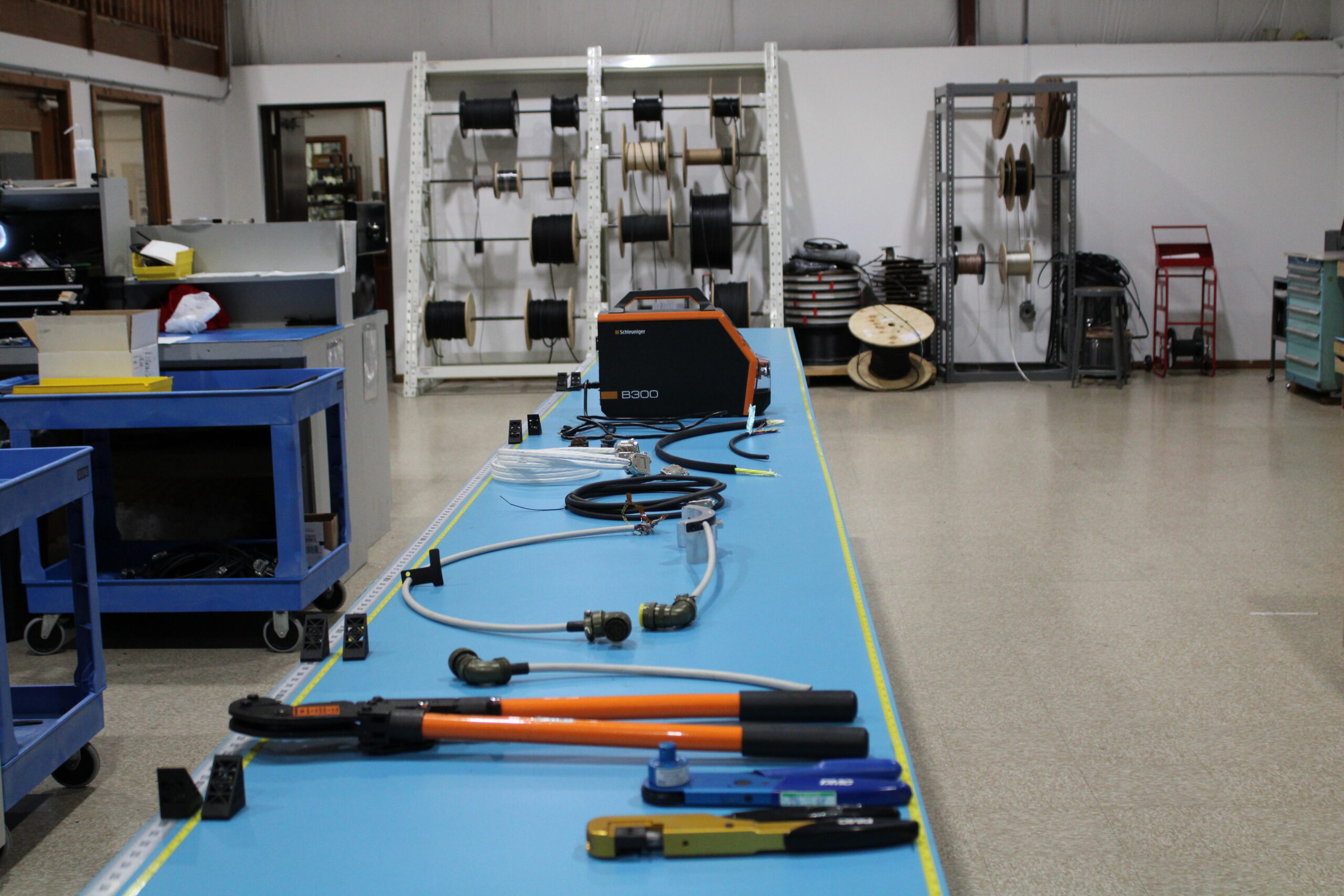
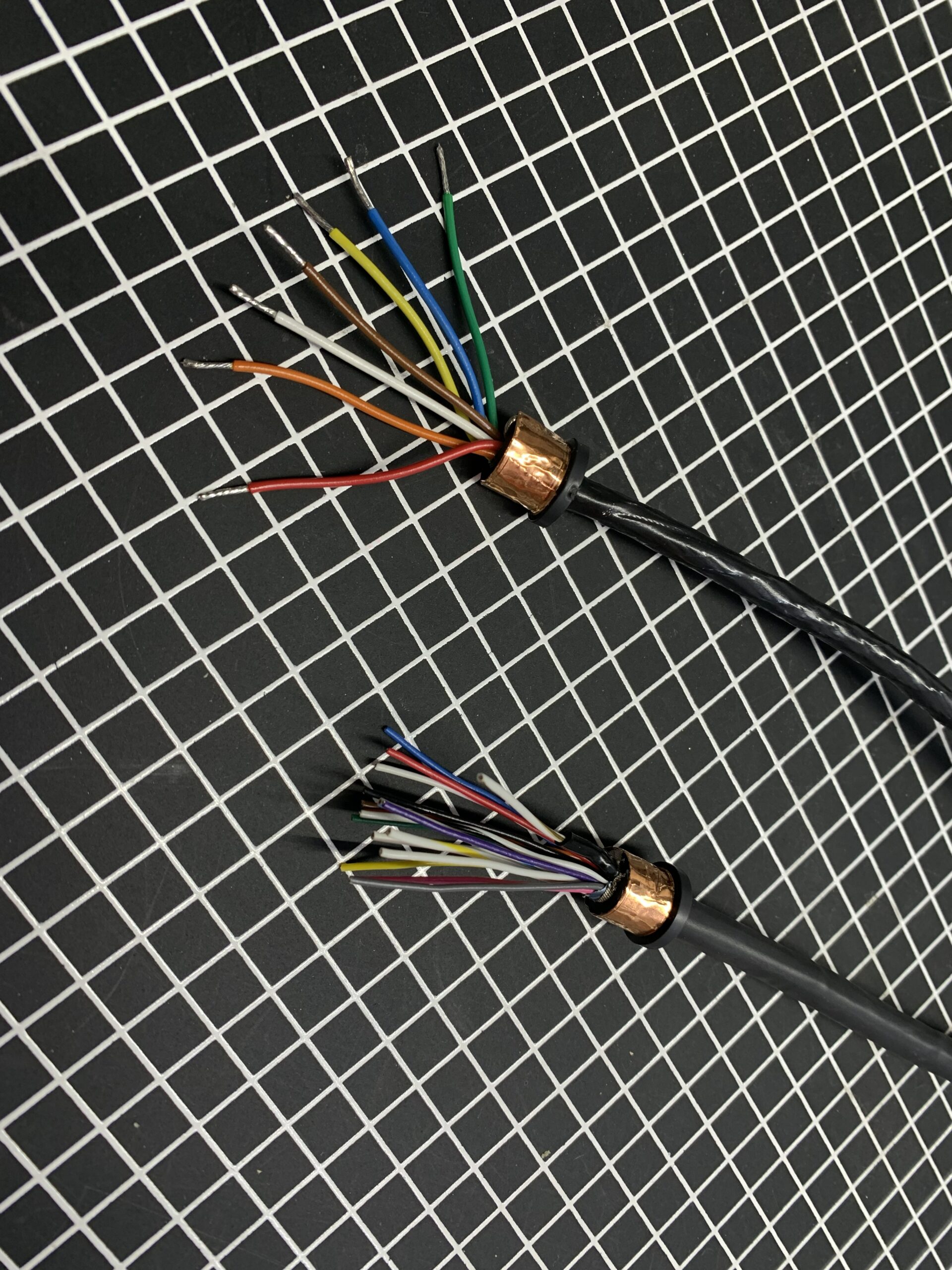
At Kiski Precision, our work ranges from straightforward cable assemblies to custom wire harnesses built entirely from discrete wire. Many projects start with preconstructed cable that we prepare and terminate to the customer’s connectors. Others require us to build the harness from the inside out, routing discrete wire, adding braided sleeving and finishing with heat shrink. We also build internal harnesses for motion equipment, including the limit switch cabling installed in linear translation stages.
D-sub connectors account for the largest share of our work, in solder cup, insulation displacement (IDC) and crimp configurations, and we have terminated tens of thousands of them. We have also terminated thousands of mil-spec circular connectors over the life of the department.
Most of the wire we work with falls between 22 and 16 AWG, although we regularly handle gauges from 28 AWG to 8 AWG. Our tooling accommodates wire from 28 AWG up to 4/0, and the heaviest wire we have used in a build to date is 3 AWG. Harness lengths extend to approximately 50 feet.
Because many terminations require a dedicated crimp tool, we maintain a growing tool inventory that ranges from general-purpose crimpers to specialty tooling for terminations such as Hirose. Finished cables are identified with wraparound labels or mil-spec double-wall heat shrink labels, depending on the customer’s requirements.
Every Cable Is Tested
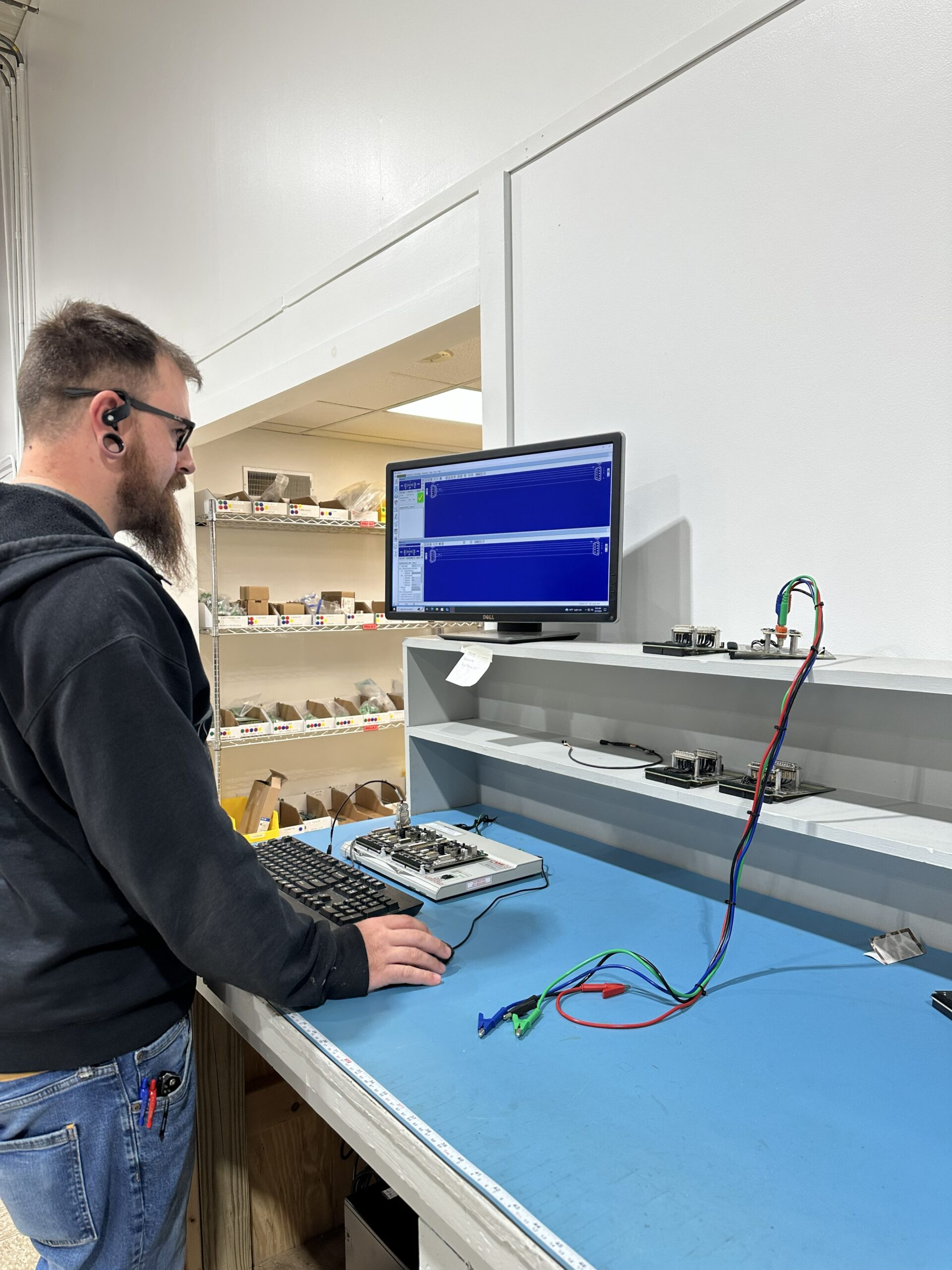
We test every cable we build, not a representative sample. Our testing capability has grown with our customers’ requirements: the department began with continuity testing and added hipot and insulation resistance testing as programs called for them. Today we operate two CableEye test systems, one for continuity testing and one for hipot and continuity testing, and our technicians supplement automated testing with manual spot checks using digital multimeters.
The CableEye platform also allows us to build our own test fixture boards. Standard boards cover D-sub and RJ45 connectors, but mil-spec connectors call for something more specific, so we have built a custom board for every mil-spec connector we have worked with. Our hipot tester, insulation resistance meter and crimp tools are all calibrated on a one-year cycle.
Inspection is a two-person process. The technician who builds a harness runs the automated point-to-point test, and a second team member then verifies length, labeling and connector orientation before signing off. Because no one inspects their own work, every harness is reviewed by a second person before it ships.
Some harnesses are verified again once they are installed in a larger unit. The limit switch harnesses we build for linear translation stages are one example. Each completed stage runs a limit-to-limit burn-in test, and because that test depends on the limit switches functioning correctly, a wiring error would cause the stage to fail.
Test records are available on request and should be specified at the quote stage. For each cable, we can provide a printout of every pin connection along with its resistance and insulation resistance readings. The documentation package also includes a summary sheet showing how many cables were tested, the pass or fail result for each and when the tests were performed, as well as the schematic the cables were tested against.
From Purchase Order to Shipment
Every order is entered as a job in our ERP system, with a bill of materials that drives material picking for that job. A technician builds the harness and confirms length and labeling, then runs the automated test before passing the harness to a second team member for final inspection. Labor and materials are recorded against the job from start to finish, which allows us to track cost and labor on every build. When final length or connector clocking is critical, we use fixtures, either built in-house or supplied by the customer, to hold those requirements.
When a customer supplies a kit of materials, we lay out and inspect every item before any work begins, confirming that quantities are correct and that each part matches the job requirements. Missing quantities and incorrect parts are common in supplied kits, and finding them before the build starts gives the customer time to correct the issue before it affects the schedule.
Working From Your Documentation
Complete schematics and electrical drawings remain the best starting point for any cable harness assembly. When a customer does not have them, however, we can work from less formal documentation. On one current program, no schematic exists at all. The project began with a Word document from the customer, which we converted into a spreadsheet and developed together with the customer’s engineers until it became a controlled document. Working this way requires more collaboration, but it allows the customer to move forward without a full drawing package while retaining complete control of their product.
As a manufacturer of build-to-print cable assemblies, we treat all job documentation as the customer’s property. When we find an error in a drawing, we raise it with the customer rather than correcting it on our own. In one instance, a drawing showed the same connector two different ways in separate views. Discrepancies of this kind are not unusual, and we work through them with the customer and request a revised drawing so that future orders are built correctly.
Volume and Lead Times
Prototypes and first articles typically require one to three weeks, depending on complexity and the work already in progress. Production runs of dozens to hundreds of cables typically require several more weeks once documentation is finalized, and expedited schedules are available in some situations.
Throughput varies widely with cable complexity and the type and detail of documentation available. A simple ground cable could be done in minutes, while something more complex might take hours. In addition, complete and detailed documentation will always help with efficiency.
Our largest orders to date as a wire harness manufacturer were two military programs of approximately 1,100 cables each. Every cable in those programs was built from discrete wire, and each program ran for three and a half to four months.
When a program calls for a one-time increase in volume, we bring in team members from other departments to handle preparation work, such as cutting wire to length, so that our skilled technicians can stay focused on terminations and soldering. When a program settles into steady annual volume, we add staff to the department.
Completing a Program Already in Progress
Our first military job as a custom cable assembly manufacturer came to us partially complete. Another contractor had started the work, and the batch was in the middle of production when it arrived. Our team reviewed the existing documentation, verified the work that had already been performed and completed the order, resolving several issues with the customer along the way.
That job led to the larger military orders that followed. We believe what earned that work was our willingness to build the cables exactly as the customer wanted them built and to work through the details alongside their team.
FAQs
What workmanship standard do you build to?
We build to IPC/WHMA-A-620, Revision E. Class 3 is our goal on every build, and when a customer specification calls for a different class, we build to that specification. Unless a customer specifies otherwise, every cable and electrical assembly we produce follows IPC standards.
Are your technicians IPC certified?
Yes. One of our technicians holds a Certified IPC Trainer (CIT) certification and trains the team in-house, and the other five technicians in the department hold Certified IPC Specialist (CIS) certification.
Do you test every cable?
Yes. We test 100% of the cables we build rather than a sample, and continuity, hipot and insulation resistance testing are all performed in-house.
What test documentation can you provide?
On request, we can provide a pin-by-pin printout for each cable with its resistance and insulation resistance readings, a summary sheet showing quantities tested and pass or fail results, and the schematic used for testing. Because documentation is provided only when requested, we ask customers to specify their requirements at the quote stage.
Do you perform pull testing?
Yes, when a customer requires it. We use a force gauge to measure pull strength, and we do not perform destructive testing unless a customer requires it.
Can you build a harness without a complete drawing?
Yes. We have built harnesses from schematics and spreadsheets in place of finished drawings. This approach requires closer collaboration with your engineering team and works best when someone on your side is available to answer questions as the build develops. For high-volume work, we prefer to start from complete documentation.
What happens if my drawing contains an error?
We bring it to your attention and work with you to resolve it. Because the drawing belongs to you, we ask that you issue a revision so that future orders are built correctly.
Should I supply the materials, or should you purchase them?
That depends on the program. For one-time jobs or fixed quantities that will not repeat, we generally prefer that the customer supply the materials. For work that recurs year after year, it is more practical for us to purchase and stock inventory, which also allows us to keep extra components on hand to replace parts damaged in shipping or handling, or parts that arrive defective.
Do you track material lots?
For repeat customers, yes. That inventory is tracked in our ERP system. For one-time jobs, materials are purchased specifically for that job.
What wire gauges and connectors do you work with?
Most of our work falls between 22 and 16 AWG, and we regularly work with gauges from 28 to 8 AWG. Our tooling accommodates wire up to 4/0. D-sub and mil-spec circular connectors are the connector types we handle most often.
How do you label cables?
We apply wraparound labels or mil-spec double-wall heat shrink labels to your specification. We do not print directly onto wire.
What is your typical lead time?
Prototypes and first articles typically require one to three weeks, and production runs of approximately 50 cables typically require two to three weeks once documentation is finalized. Expedited schedules are available when a program requires them.
What wire harness assembly services do you not perform?
We do not perform surface mount PCB assembly, overmolding or molded connector work, and we do not print directly onto wire. For PCB work, we can refer you to partners in our area. If a specialty process is part of a recurring program, we are open to discussing it.
